

It’s 8:00 a.m. on Wednesday morning, and Mariana Franey is already at work. Her fellow volunteers at the Berwick Food Bank in Berwick, Nova Scotia sort potatoes, carrots, onions and apples, restock shelves, and put together orders that will go out for delivery. As the co-manager, Mariana supervises the other 17 or so volunteers, organizes drivers for deliveries, and helps where she can.
Each delivery order — a service that started during the COVID-19 pandemic and that has become a lifeline for those without transportation in the rural community — comes in the night before and is handpicked by volunteers.
“There’s about five of us going every which way … getting the orders together,” says Mariana.
After the delivery orders are done, Mariana and the team spend the rest of the day doing a variety of tasks: sorting the food delivery from the National Food Sharing System via Food Banks Canada and the provincial food banking association Feed Nova Scotia; working with the delivery drivers; bagging coffee, tea and pet food; and checking messages.
“Then there are people dropping in with donations. I must say not as much as before. I think people are having a hard time now, and they really can’t give us the donations like they used to,” says Mariana.
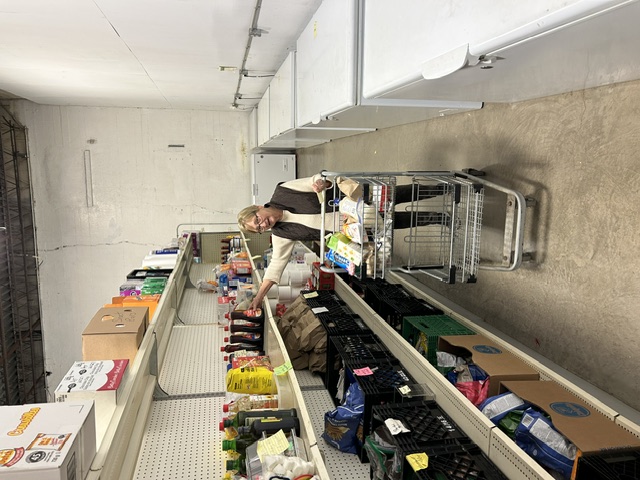
It’s a lot of work for an organization that is volunteer-run — something common to a lot of smaller food banks in rural communities across Canada. And many of those volunteers are retirees. “We have about 66 volunteers,” says Mariana, “And I can tell you that most everybody is over 65. Some of us are in our 80s.”
Mariana worries about the future. With more families relying on it each month, the food bank is essential to the small community. But without younger volunteers, succession planning is a challenge.
The Berwick Food Bank is not alone in its need for volunteers. In a survey conducted last year by Food Banks Canada, nearly half (48%) of food banks say they don’t currently have enough volunteers to effectively manage operations.
Thankfully, finding enough volunteers for most roles is not a problem for Meg Musy, Volunteer Programs Specialist with Food Banks Mississauga in Ontario.
“It’s a great problem to have,” Meg says. “We have more interest than we have roles sometimes.”
But supporting the community is still a crucial endeavour. One that Patricia (Pat) Howe, Volunteer Lead at Food Banks Mississauga, recognized during the COVID-19 pandemic when she decided to start volunteering.
“I saw how people were unable to feed themselves at increasingly large numbers and were desperate,” she says.
While food sorting and preparing orders for Food Bank 2 Home, a home-delivery program, is part of Pat’s job, so is mentoring younger volunteers, such as local high school students, or supervising corporate volunteers who come to lend a hand. Pat recognizes the importance of exposing more people in the wider population to food banks through these sorts of visits. She acts as an ambassador for the organization, highlighting the critical role it plays in the community and helping to break down the stigma that surrounds food banks.
“It’s hard to come to a food bank and ask for food, yet people have an unfortunate attitude that people abuse food banks,” says Pat. “I’ve talked to moms who have come at their last chance, their last hope, and they’re at the food bank and they’re crying because they had to come to do this.”
Millions of people in Canada rely on a food bank for their next meal. Collectively, Canada’s food banks receive nearly 2.2 million visits every month. A third of the people they serve are children.
While volunteering at a food bank has its challenges, both Pat and Mariana agree that seeing their impact in action makes it a rewarding experience.
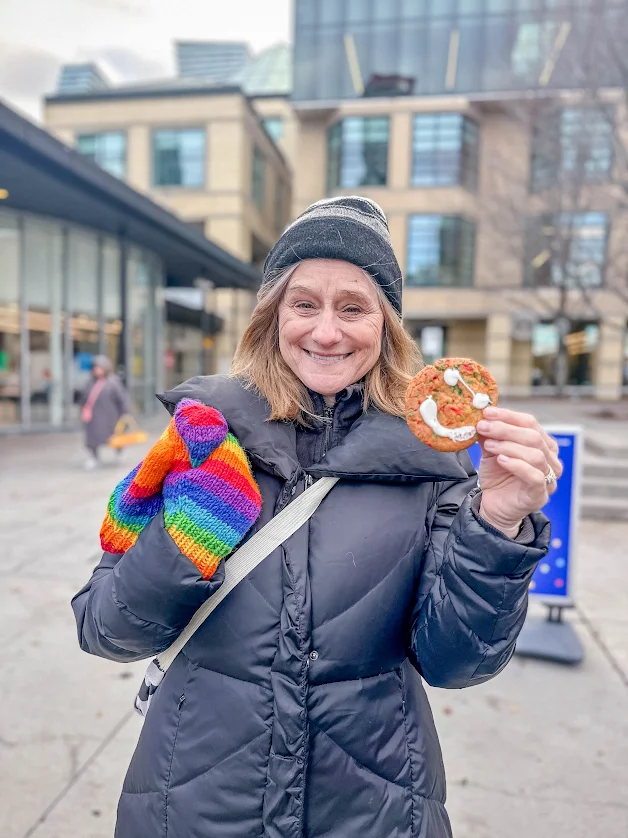
“When I retired, I wanted something to fill a void,” says Mariana. “And I can tell you, I sure found it. I know we’re making a difference.”
Pat shares one client visit that has stayed with her. “When the war in Ukraine started, we had a lot of people coming in. There was a mom with a baby and a toddler holding her hand. She had nothing but a suitcase, and her husband was fighting in Ukraine.”
The food bank provided the woman with food and diapers. “It was so deeply sad, and yet we were able to do a little bit to help. It’s the tiny moments where you feel like you really helped that make a difference.”
Depending on the community and the needs of the organization, volunteering for a food bank can mean working in a warehouse, garden, farm, kitchen, truck, office or client-facing role. It can mean research, administration, social media coordination, fundraising and special events, building maintenance, or serving on the board. But many of these skills can be learned on the job. Anyone can potentially volunteer, no matter their skill level, education, or age. Some roles are large time commitments, while some only call for modest amounts of time.
The United Nations has declared 2026 International Year of Volunteers to highlight the importance of the role of volunteering in addressing global goals such as ending poverty and protecting the planet.
“We’re so thankful to the community for stepping up and volunteering where they can,” says Meg. “We get so many people who say, ‘I’d love to be a donor, but I can’t afford it, so this is how I want to give back’. And we’re so happy that we have that support in the community.”
If you are interested in making a real impact in your community, please contact your local food bank and ask about volunteering opportunities today.