

As summer comes to a close, children across Canada are getting ready to head back to school. While many will carry backpacks stuffed with pens, paper, books, and tablets, it’s what’s in their bellies and lunchboxes that could have a greater influence on their success.
Unfortunately, many students show up to class hungry.
It’s a problem that The Salvation Army in Fort Frances, which operates a food bank in northern Ontario, is all too familiar with. “Many families in the community face economic challenges, with rising food costs impacting student well-being,” said the organization in a report to Food Banks Canada. “Schools report increased demand for nutrition programs, as hunger hinders learning.”
Fort Frances is not alone. In 2024, 27 percent of Canadians in two-parent families with children experienced some level of food insecurity, along with 44 percent of people in single-parent families. And one third of the country’s food-bank clients are children under 18.
That’s part of the reason why, in 2024, the Government of Canada announced the National School Food Program, which would invest $1 billion in school food programs over five years via the provinces, the territories, and Indigenous partners. In 2025, it made the program permanent.
As of this school year (2026-27), roughly 80 percent of Canada’s public schools — including all of those in PEI, Nova Scotia, and New Brunswick — offer free, affordable, or pay-what-you-can food programs for students. The federal government aims to shore up this progress and help fill the remaining gaps as the National School Food Program continues.
Many school food programs — provincial/territorial, regional, or local — control costs and strengthen the community by partnering with nonprofit organizations such as food banks, which provide the food and/or prepare the meals.
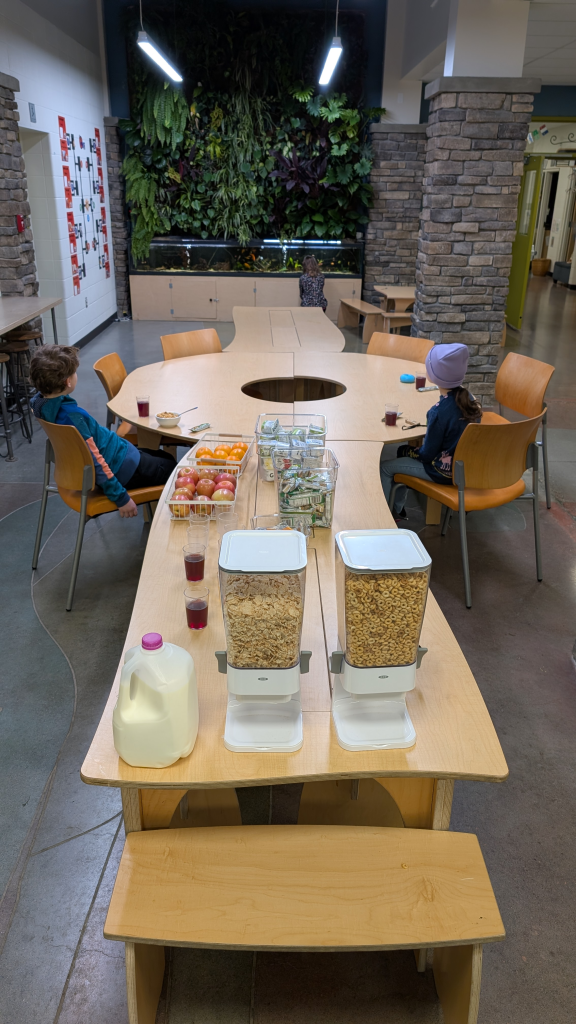
An example of how this can work is La Cantine pour tous, active in 263 schools in Quebec. This organization administers school lunch programs where parents pay what they can for each meal, ranging from $1 to $6 — or more if families are able and willing to provide extra support. Families who ordered lunches are recorded, but the amount they paid is not, which helps the program avoid stigmatizing students.
La Cantine pour tous’s partners include food banks, such as Moisson Beauce in the region south of Quebec City. The food bank provides meals to schools in the area and is paid a consistent fee for this service by La Cantine pour tous, which fundraises to make up the difference if government support and payments from school families don’t cover the fee. Moisson Beauce invests its modest profit into its food-aid programming for people in need. It’s a win-win.
So, to complement the National School Food Program, Agriculture and Agri-Food Canada launched the School Food Infrastructure Fund (SFIF), which invests in infrastructure and equipment that allow organizations like Moisson Beauce to enhance and grow their contributions to school food programs.
In 2025, Food Banks Canada was selected to distribute $1.6 million in SFIF support, which it granted to 24 food banks and community organizations. The funds were used to:
- increase food banks’ capacity to provide food to local school programs
- improve the availability of nutritious and culturally appropriate foods in those programs
- expand the reach and impact of those programs
Altogether, these investments translated into immediate and recurring nutrition for over 8,000 additional students while building long-term community food capacity.
One organization that received a portion of these funds was The Salvation Army in Fort Frances. Before receiving an SFIF grant, volunteers used their personal vehicles to transport food, limiting how much and which types of food they could provide to local school food programs. With the purchase of a dedicated delivery vehicle, The Salvation Army was able to increase the quantity and quality of food provided, delivering more than four times as many meals to hungry students.
The Salvation Army in Fort Frances says that SFIF funding played a critical role in reducing food insecurity among students in the community. The organization reports that at one elementary school, students who previously arrived hungry were noticeably more engaged and focused once food supports were introduced. A school staff member shared, “We’ve seen a change: students are calmer, better able to concentrate, and more willing to participate in class when they know they will not go hungry.”
Access and Quality
Research bears out the idea that food access matters when it comes to learning. When children attend school hungry, their energy levels, memory, problem-solving skills, and other cognitive functions are all negatively impacted. Food also improves school attendance: for example, a study of kindergarteners in New York City found that access to free school meals reduced chronic absenteeism by 5.4%.
The types of food provided also matter. There is room for improvement in patterns of eating in Canada, with health surveys from Statistics Canada showing that only a minority of people — children included — eat the recommended amount of fruit or vegetables each day.
Through the SFIF, food banks and community organizations are working not only to provide enough food for students, but also the right kinds of food to fuel learning and development.
“Before the food bank received the new fridge and freezer, our school delivery program often had to limit fresh items due to lack of storage space,” reports Ardis Proulx-Chedore of Cochrane Food Bank in Cochrane Ontario. “Since the installation, we have been able to keep larger quantities of fruits, vegetables, dairy, and prepared snacks on hand and deliver them consistently to schools.”
One educator at a school served by Cochrane Food Bank shared, “The difference is remarkable. Students who used to skip breakfast now have access to fresh food every day, and we see noticeable improvements in their focus and behaviour.”
“Thanks to the SFIF program, we’ve seen a significant reduction in food insecurity in our neighbourhood,” reports Samantha Campbell, Moosomin Food Share, Moosomin, Saskatchewan. “Families who once struggled to provide nutritious meals now have access to fresh, local produce, which has improved both their health and their financial stability.”
Food Banks Canada is also working with food banks across the country to extend food support to children during the summer months when school food programs are unavailable. Learn more about our After the Bell program.