

At Food Banks Canada, we believe that food banks open doors: they allow for everyone to support one another through life’s challenges and pursue possibilities. We’re grateful to the people who’ve generously agreed to share their stories to show how this truth plays out in the lives of our families, friends, and neighbours.
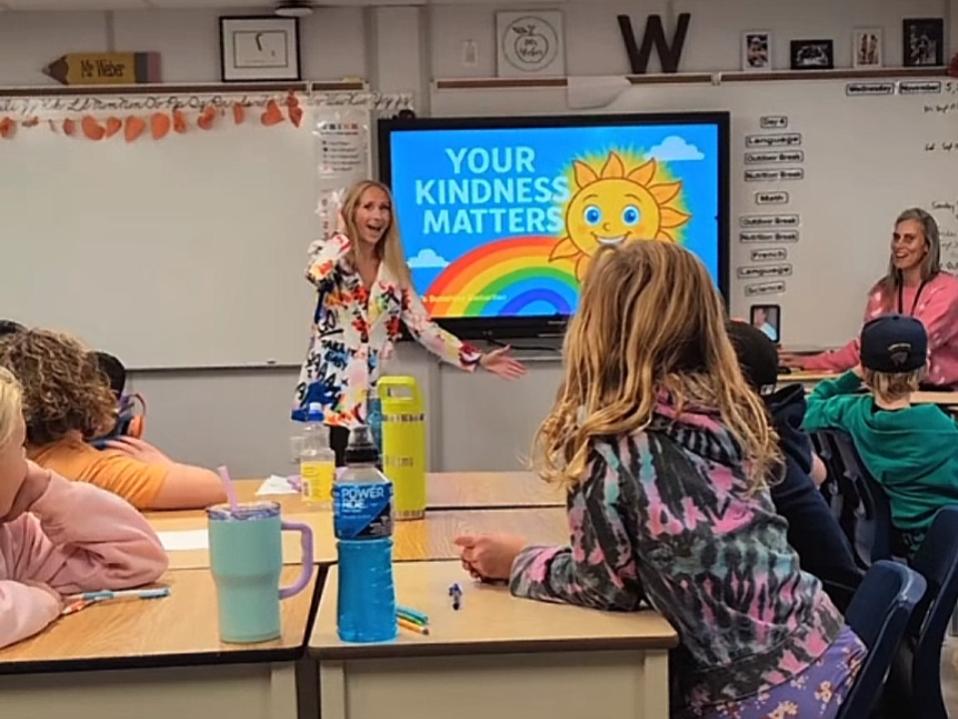
Kitty Ibele is an enterprise account executive with Panopto, an AI video platform for education and training. But her alter ego is the Sunshine Samaritan, a role that sees her doing whatever she can to boost someone’s day in her home region of Kitchener-Waterloo. Over the years, that’s included actions from bringing flowers to a local nursing home, to dropping by construction sites with coffee, to walking downtown with big posters that say “You are beautiful.” She says the reactions everywhere are their own reward. “As people were driving or walking by, you could see the smiles and the impact it made. Even just a little smile is worth it,” she says. She also volunteers throughout the city.
Ibele says she is driven to give back because the challenges she’s faced in her own life have made her aware of how much a kind word or action can mean. During her student days at the University of Waterloo, she became homeless due to an unfortunate family situation. “I was completely on my own,” she says. “I had no idea what to do. At first, I was just roaming the university. Education means everything to me. I was going to do that no matter what.”
But with all her money going towards tuition, she didn’t have anything left over. “I was sleeping on the couches at the Student Life Centre,” she recalls. “Sometimes I was sleeping in a Tim Hortons washroom stall. The washrooms were the best spot because you could lock the door and that made it safe.”
One day, Ibele was peeking into the garbage, looking for any leftover food, when a university custodian approached her and asked what she was doing. She admitted she didn’t have anything to eat. The custodian ended up buying her lunch and then telling her that the Student Centre had a food bank.
“Immediately, that was a total game changer,” Ibele says. “I ended up going in multiple times a day to get breakfast, lunch, and dinner, and even snacks. I was literally dealing with fainting spells; I was 80 pounds. Then all of a sudden, I could focus in class. It just helped build me up.” She was even able to get menstrual products, toothpaste, deodorant and shampoo that she could use in the showers at the university.
With her hunger at bay, Ibele was able to gradually focus on finding work. She picked up various part-time jobs, working as a videographer for the Federation of Students and in seasonal positions with various retailers during the holidays.
“And even then, the food bank still helped, because all the money was going towards tuition and subletting a tiny room. So I still didn’t have enough for food at that point,” she says. She used the food bank for the remaining years of her university career.
Looking back, Ibele is thankful to have found the food bank and encourages other students to seek them out if need be. She also encourages food banks at universities to advertise widely so students know they are there. “Spreading awareness is such a massive role, because if it wasn’t for one of the custodians at the University of Waterloo telling me, I never would have known,” she says. She did appreciate, however, that the facility itself was tucked away on a second floor for greater privacy.
She also hopes that stigma around both homelessness and food insecurity will diminish. “When I was dealing with homelessness, a lot of people assumed that I was not, because I don’t really play into the stereotypes,” she says. “I’ve chatted with people who are so judgmental about people in those circumstances, and as they’re talking to me, they don’t realize that I’ve been in those circumstances myself. So I think not judging is so important for breaking through barriers and helping the people that really need it.” And, she says, so is realizing the impact that kindness — even just a little smile — can make.

