Canada has a generational opportunity to reduce poverty- read the Food Banks Canada Poverty Report Cards.

Canada 2026 Poverty Report Card

Overall Grade:

D+

Experience of Poverty

Experience of Poverty

Indicator Data
2026 Grade
People Feeling Worse off Compared to Last Year
39%
C+
People Feeling Worse off Compared to Last Year
Data:39%
2026 GradeC+
People Paying More than 30% of Income on Housing
42%
F
People Paying More than 30% of Income on Housing
Data:42%
2026 GradeF
People Having Trouble Accessing Healthcare
24%
F
People Having Trouble Accessing Healthcare
Data:24%
2026 GradeF
Government Support Recipients Who Say Rates are Insufficient to Keep up with Cost of Living
66%
F
Government Support Recipients Who Say Rates are Insufficient to Keep up with Cost of Living
Data:66%
2026 GradeF
Percent of Income Spent on Fixed Costs beyond Housing
55.9%
C
Percent of Income Spent on Fixed Costs beyond Housing
Data:55.9%
2026 GradeC
Overall Grade D+
Overall Grade: D+

Canada received a D+ grade in 2026, driven primarily by a sharp deterioration in perceptions about the adequacy of government support combined with sustained affordability pressures.  


Housing affordability: In 2026, 42% of Canadians spent 30% or more of their income on housing. In 2023, this figure was 36%. It jumped to 43.6% in 2024 and has remained in the low 40s ever since. The data suggest an affordability shock followed by entrenchment.


Income spent on fixed costs outside of housing: Canadians devoted just under 56% of their income to fixed costs in 2026. This figure has been essentially the same since 2023. Year‑to‑year movement has been minimal, indicating persistently high pressure from essential costs.


Access to health care: The share of people reporting difficulty in accessing care rose steadily from about 19% in 2023 to 24% in 2026.


Worse off than last year: Nationally, the share of people who feel worse off than they did last year increased from about 43% in 2023 to 44% in 2024, before falling to 39% by 2026. This indicates some easing in perceived hardship, but levels remain high.


Adequacy of government support: This is the clearest and most concerning shift. The share of people who receive government support and say it is inadequate rose sharply from 45.9% in 2023 to 65% in 2025, and increased again to 66% in 2026. This represents a sustained and substantial deterioration, pointing to rapidly growing unmet need and declining confidence in income support systems nationally.


Key Findings

Poverty Measures

Poverty Measures

Indicator Data
2026 Grade
Poverty Rate (MBM)
11.1%
F
Poverty Rate (MBM)
Data:11.1%
2026 GradeF
Unemployment Rate
6.7%
F
Unemployment Rate
Data:6.7%
2026 GradeF
Food Insecurity Rate
24%
F
Food Insecurity Rate
Data:24%
2026 GradeF
Overall Grade F
Overall Grade: F

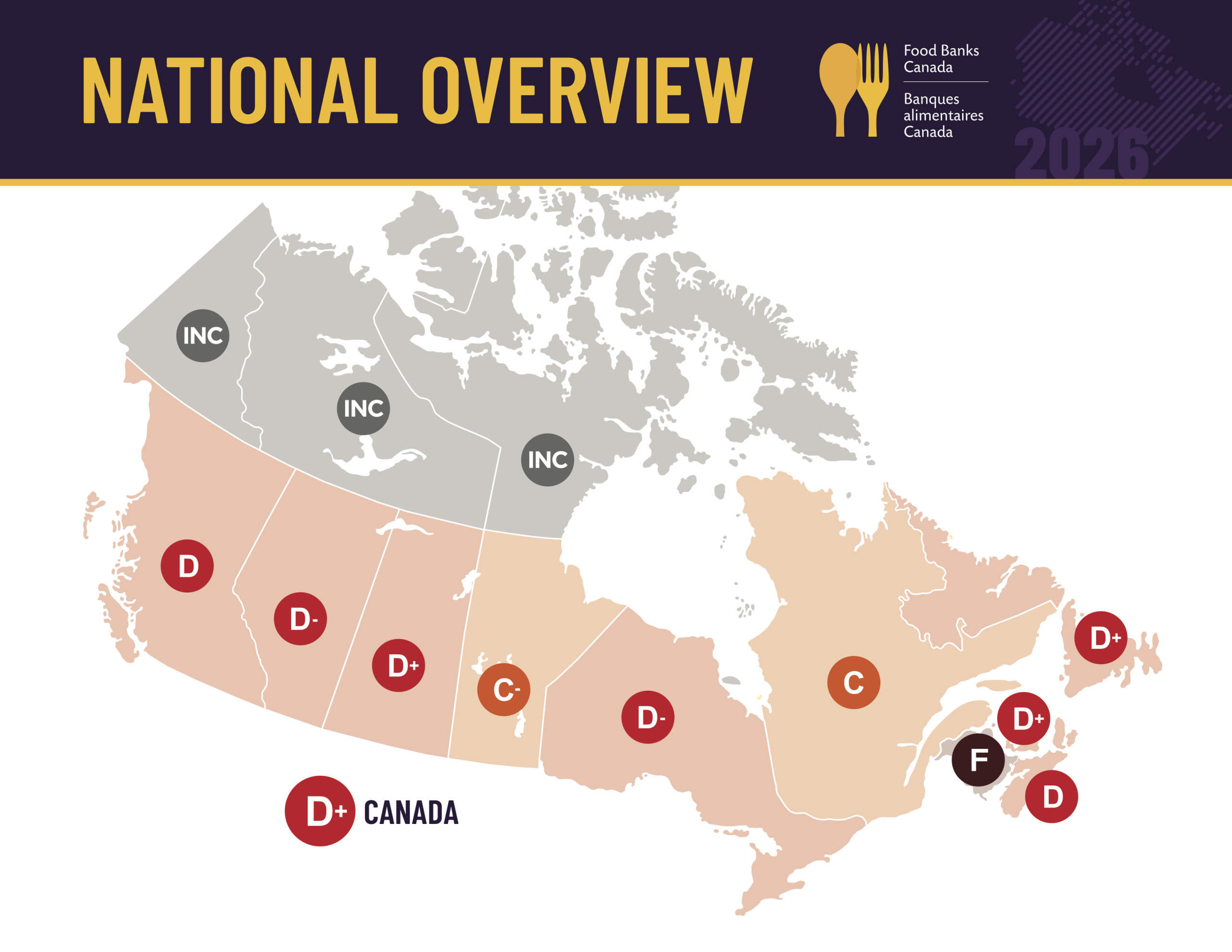
Canada received an overall grade of F in the poverty measures section. Quebec received the highest provincial grade (C), while the national picture reflects broadly weak performance across all indicators with little sign of meaningful improvement in recent years.


Poverty rate:

The most recent available data (from 2024) show the national poverty rate is 11.1%, reflecting a significant increase from the 2023 baseline of 7.4%. Quebec reports the lowest poverty rate among provinces at 7%, while Nunavut records the highest rate in the country at 31.7%.


Social assistance as a percentage of the poverty line:

Nationally, data on social assistance as a percentage of the poverty line are not available as a single comparable figure. Among provinces, Prince Edward Island performs strongest on this measure, with benefits covering 64.4% of the poverty line, while Nova Scotia performs weakest at just 30.9%.


Disability assistance as a percentage of the poverty line:

As with social assistance, a single national figure for disability assistance as a percentage of the poverty line is not available. Among provinces, Newfoundland and Labrador leads this indicator at 74.1%, while Alberta records the lowest rate at 38.7%.


Unemployment rate:

Canada's national unemployment rate is 6.7%, up from 5% in 2023. Saskatchewan has the lowest provincial unemployment rate at 5%, while Newfoundland and Labrador records the highest among provinces at 9.5%.


Food insecurity:

The most recent available data (from 2025) show that 24% of people in Canada live in households experiencing food insecurity, a deeply troubling figure representing nearly 1 in 4 Canadians. Quebec reports the lowest provincial rate at 18%, while Nunavut records an alarming rate of 56.4%.


Key Findings

Material Deprivation

Material Deprivation

Indicator Data
2026 Grade
Inadequate Standard of Living
28%
B-
Inadequate Standard of Living
Data:28%
2026 GradeB-
Severely Inadequate Standard of Living
19%
B-
Severely Inadequate Standard of Living
Data:19%
2026 GradeB-
Overall Grade B-
Overall Grade: B-

Canada received a B− grade for material deprivation in 2026. 


This grade represents an improvement from a C+ in 2025 and reflects an ongoing positive national trend. 


Severe deprivation declined slightly to 19%, and inadequate deprivation stabilized at 28%. The data suggest that the most severe hardship has eased and broader deprivation is not becoming worse. Across the country, deprivation levels stabilized in 2026, albeit at quite high levels. Material deprivation decreased meaningfully in Manitoba and Quebec but rose sharply in Nova Scotia. 


Overall, the national material deprivation results indicate modest gains between 2024 and 2025, but little change over the last 12 months. This indicates that material deprivation persists. 

Key Findings

Legislative Progress

Legislative Progress

Indicator Data
2026 Grade
Legislative Progress
C
Legislative Progress
Data:
2026 GradeC
Overall Grade C
Overall Grade: C

Affordability and Cost of Living 

  • Introduced measures to reduce everyday financial costs, including a $10 cap on non-sufficient funds (NSF) fees (down from as high as $50), enhancements to low- and no-cost bank accounts, and faster access to deposited funds. These changes are expected to benefit households that live paycheque to paycheque.  
  • Reduced the lowest marginal personal income tax rate from 15% to 14%, effective July 2025. This change is expected to benefit nearly 22 million Canadians. The largest share of tax relief is expected to go to those in lower tax brackets.  
  • Announced the Canada Groceries and Essentials Benefit, a key Food Banks Canada policy recommendation, a five-year, $12.4 billion program that will provide up to $950 for individuals and $1,890 for families of four annually through the tax system. Twelve million Canadians living on lower incomes are expected to benefit from this program. 
  • Renewed funding for the Community Volunteer Income Tax Program for three years. This program supported over 1 million tax filings last year and improved access to benefits for households with low incomes.  
  • Announced $20 million to help food banks and community organizations deliver more nutritious food.  
  • Committed $216.6 million annually to make the National School Food Program permanent. An additional 400,000 children will benefit from this commitment every year.  


Housing Supply and Infrastructure 

  • Launched the Build Canada Homes agency with a $13 billion commitment to build 4 million homes by 2031. However, a significant skilled labour shortage — estimated to reach 309,000 workers by 2030 — may hinder delivery.  
  • Advanced a series of federal–provincial and municipal housing agreements to accelerate supply, including partnerships in OntarioBritish ColumbiaNova ScotiaNew BrunswickNunavut, and Ottawa. These agreements are expected to support the construction of at least 7,480 new homes, including dedicated affordable and community housing units, backed by over $1.3 billion in federal and joint funding. 
  • Eliminated the GST for first-time homebuyers on new homes priced at up to $1 million, with partial relief on homes costing up to $1.5 million. 
  • Expanded high-speed Internet access through partnerships with AlbertaSaskatchewan, and Nunavut, reaching approximately 96,000 additional households and improving access to essential services and economic participation.  
  • Signed early learning and childcare partnership extensions with Saskatchewan and British Columbia through 2030–31, and one year extensions with Ontario and Alberta. (See here for a full list of program extensions.) 


Income Security 

  • Implemented the Canada Disability Benefit (CDB), which will provide up to $2,400 annually for eligible low-income Canadians with disabilities aged 18–64. This is a significant new federal income support, but concerns over eligibility restrictions and the adequacy of the support remain. 
  • Increased the Canada Child Benefit by approximately $200 annually, with maximum benefits reaching $7,997 for children under 6 and $6,748 for those aged 6–17.  
  • Raised the federal minimum wage to $18.15 per hour, effective April 1, 2026, maintaining indexation to inflation.  
  • Began implementing automatic tax filing for Canadians with low incomes. This initiative is expected to reach 5.5 million individuals and improve uptake of benefits such as the CCB and GST/HST credit.  


Labour Market and Employment Supports 


North and Indigenous 


Canada received a C for legislative progress this year. The federal government introduced a range of affordability and income-support measures, including the Canada Groceries and Essentials Benefit, enhancements to the Canada Child Benefit, the introduction of the Canada Disability Benefit, and the permanence of the National School Food Program. Additional changes, such as automatic tax filing for low-income households and expanded access to low-cost banking, also aim to reduce everyday financial barriers.  


However, these actions remain insufficient relative to the scale of need. While the Canada Groceries and Essentials Benefit represents a significant new transfer, its overall design and scale are more limited than earlier policy intent, constraining its ability to materially reduce food insecurity. Similarly, the Canada Disability Benefit is a meaningful policy development but is restricted by eligibility rules tied to the Disability Tax Credit, excluding many low-income people with disabilities who are among those most at risk of poverty. 


Labour market supports remain a critical gap. Temporary Employment Insurance measures have been extended, but no structural reforms were introduced to address persistent gaps in coverage and eligibility, particularly for younger and non-standard workers. Gaps in EI access not only limit income stability but also restrict pathways into further employment and training supports. 


Housing affordability pressures also remain acute. Federal investments in housing supply, including through Build Canada Homes represent a significant commitment to long-term expansion – but housing takes time to build. Uncertainty surrounding time-limited affordability measures, including the Canada Housing Benefit, raises concerns for households currently facing high rental costs. 


The most significant area of promise is in the North.  Federal investments in housing, infrastructure, and connectivity represent a potentially important shift in long-term support. These investments have the potential to improve living standards if designed and implemented in partnership with Indigenous, and community leadership.  


At the same time, key federal programs addressing food insecurity remain uncertain and in transition. We are still awaiting on reforms to Nutrition North Canada, while recent changes to the Inuit Child First Initiative have created uncertainty and reduced access to food supports. This uncertainty makes it difficult for communities to plan and highlights the limitations of temporary and piecemeal approaches in addressing systemic challenges.  


Overall, the federal government has made important progress, but gaps remain. Opportunities exist to strengthen the adequacy and accessibility of income supports, implement meaningful Employment Insurance reform, and ensure that major investments translate into lasting reductions in poverty. 

Key Findings

Political And Policy Landscape

Canada is at an inflection point. The pressures shaping today’s affordability crisis are no longer episodic or confined to specific shocks. They are a result of deeper structural shifts in how income, housing, and work interact in the Canadian economy. Global disruptions have intensified the pressures, but they have not created them. Long before inflationary shocks and supply chain volatility, core elements of Canada’s social and economic systems were already showing signs of decline. The recent volatility has exposed just how far those systems have fallen behind current needs. 


Since 2021, food and shelter costs have increased by 30%, far outpacing wage growth. At the same time, the nature of work itself has become less stable. Overall unemployment has stabilized above 6% nationally, following a sustained increase over the past two years. Youth unemployment reached 13.8% in March 2026, the highest levels since the Great Recession. There are now nearly three unemployed workers for every job vacancy — a clear indication that the current labour market is increasingly difficult to enter and navigate. Stability is eroding even for those with jobs: 1 in 5 food bank clients are employed, and many of them work full-time. Work is no longer a reliable guarantee of economic security or even protection against food insecurity.  


The pressures are exposing long-standing weaknesses in Canada’s income support architecture. Employment Insurance was designed for a labour market that no longer exists. Too many workers — particularly younger workers and those in non-standard or precarious employment — are unable to access benefits when they lose all or part of their income.  


Government responses have been insufficient to address the underlying dynamics. The Federal Government has introduced a range of affordability measures aimed at reducing immediate financial pressure on households, but these interventions remain limited relative to the scale of need. The Canada Disability Benefit, while an important policy development, is constrained by eligibility rules tied to the Disability Tax Credit, excluding a substantial share of people with disabilities who have low incomes and experience poverty cannot access it. Similarly, while the Groceries and Essentials Benefit provides meaningful short-term relief, its overall impact is insufficient to close the gap between income and basic living costs for households under sustained affordability pressure.  


Housing policy remains a central pillar of the federal response, anchored by Build Canada Homes and associated investments that signal a shift toward direct supply expansion through large-scale construction targets. These efforts are supported by bilateral agreements with provinces, municipalities, and Indigenous partners, alongside measures such as GST relief for first-time homebuyers purchasing new builds. However, delivery constraints — particularly a well-documented shortage of skilled labour in construction — limit the pace at which these commitments can be realized, creating a gap between supply ambitions and near-term affordability outcomes.  


At the same time, Canada’s broader economic and political environment is being reshaped by significant geopolitical and structural shifts. The renegotiation of CUSMA, for example, reflects a broader recalibration of Canada’s trade relationship with the United States, this is being done alongside deliberate efforts to diversify international trade partnerships. These strategies are aimed at reducing economic vulnerability, but they also introduce uncertainty in the short term.  


Defence and security policy have become increasingly central to federal planning. Canada is significantly expanding its defence investment in response to a more unstable global security environment, with a growing proportion of funding directed toward Northern infrastructure and sovereignty and Arctic presence. These investments are often framed as dual use, intended to support both national security and economic development in remote regions. Northern infrastructure projects are increasingly being positioned as strategic assets that link sovereignty objectives with long-term improvements in living standards for Northern communities, which experience the highest rates of food insecurity in the country. If the Government is to achieve its desired outcomes, it will need to develop meaningful partnerships and work in co-development with Indigenous, and community leadership. 


These decisions and circumstances are unfolding in a global context marked by persistent instability in energy, fertilizer, and food markets. Conflict-driven disruptions continue to affect global supply chains and contribute to volatility in Canadian food and energy prices. These external pressures are interacting with already constrained domestic systems and amplifying affordability challenges. As a result, Canada’s policy environment is increasingly defined by the need to manage overlapping domestic structural weaknesses and external volatility simultaneously. 


The impact of all this is most acutely felt at the household level, particularly among those who have lived for many years with constrained budgets and limited financial buffers. The volatility is most visible in food insecurity, where rising costs have pushed a growing number of households into crisis, with one in four now experiencing food insecurity. Food bank usage has more than doubled since 2019, reflecting not only acute hardship but also the existence of a widening pool of households that are one shock away from instability to collapse. 


Overall, Canada’s policy and political landscape is defined less by system transformation than by incremental adaptation within existing structures. There is clear recognition of affordability pressures and meaningful expansion of targeted supports, but the support measures remain insufficiently aligned with the scale and persistence of need. Without structural reform of income security, housing affordability, and labour market protection systems, current interventions are unlikely to meaningfully reduce food insecurity or offset the pressure households are experiencing.

Policy Recommendations

Supporting Workers 


Permanent Reform to Employment Insurance for a Modern Workforce:
The nature of work has become less stable. Global uncertainty, tariffs, and persistently high unemployment are exposing long-standing weaknesses in Canada’s income support system. Even before these recent pressures, Employment Insurance (EI) was not working for a growing share of workers. 


Canada’s EI program was built for a postwar labour market defined by stable, full-time employment with a single employer. That model no longer reflects how work is organized. Over time, the labour market has shifted toward part-time, temporary, and contract work, yet EI’s core design has remained largely unchanged. As a result, the program now covers a shrinking share of workers and is increasingly out of reach for those in more precarious forms of employment, disproportionately impacting youth, those with disabilities and racialized Canadians. 


At the centre of this misalignment is the eligibility system. Access is tied to accumulating a set number of insurable hours within a fixed period, with thresholds that vary by region. This approach no longer maps onto how many people work. Irregular hours, multiple jobs, contract work, and frequent transitions in and out of employment make it difficult to qualify, even for those with consistent labour force attachment. The result is a system that works well for a narrow segment of workers, while excluding many others who face the greatest income instability. 


Canada needs a modern EI for a modern workforce, reforms should include: 

    • Expand access by establishing a uniform national eligibility threshold of 420 hours and introducing a hybrid hours-and-weeks model to better capture part-time, seasonal, and irregular work patterns.  
    • Include non-standard workers through a two-track approach: strengthen enforcement to address worker misclassification so more workers are correctly treated as employees, and create a clear contribution-based pathway for genuinely self-employed and gig workers to access EI.  
    • Improve adequacy by introducing a minimum weekly benefit floor of at least $450 and increasing the replacement rate above the current 55%, ensuring benefits better reflect the cost of living and prevent income shocks from leading to poverty.  
    • Protect access across life events by creating a separate EI stream for caregiving and illness, ensuring that accessing these supports does not reduce eligibility or duration of unemployment benefits.  
    • Strengthen employment transitions  
      • By introducing a second EI support stream for individuals who exhaust benefits without securing employment, extending access to income and employment supports for up to an additional year. This stream should be paired with enhanced training and job-matching services.  
      • In parallel, expand eligibility pathways for younger workers by counting time spent in recognized education, training, apprenticeships, and national service programs toward EI qualification, ensuring smoother transitions from education into the labour market. 


Double the Canada Workers Benefit 

Nearly 1 in 5 (19%) of food bank clients are employed, supporting a growing body of evidence showing that employment is no longer a protection against food insecurity. The Canada Workers Benefit is designed to incentivize entry into the workforce by increasing the amount of the benefit with each dollar earned, to a maximum amount. However, both the tax credit amount and the eligibility threshold limit the impact of the benefit. The CWB is phased out at a rate of 15% of each dollar of adjusted net income above thresholds of $26,855 for single individuals without dependants and $30,639 for families in 2025 – below the poverty line in every jurisdiction. The refundable credit is equal to 27% of each dollar of earned income in excess of $3,000 to a maximum credit of $1,633 for single individuals without dependants and $2,813 for families (couples and single parents) in 2025. 

Food Banks Canada recommends doubling the maximum amount of the benefit and increasing the income threshold to at least the poverty line to further incentivize workforce participation while enhancing people’s income.  


Income Policy 


Remove Barriers and Simplify Access to the Disability Tax Credit (DTC) 

The Disability Tax Credit (DTC) is a requirement to access the Canada Disability Benefit (CDB) , making it the primary gateway to federal disability supports. However, this reflects a fundamental design issue: the DTC is a non-refundable tax credit created for tax equity purposes, not income support, yet it now sits at the centre of Canada’s disability poverty reduction system.  


As a result, access to supports is constrained at the outset— Stats Can estimates that just 14.6% of persons with disabilities are eligible to claim the Disability Tax Credit, leaving the majority without access to the benefits it unlocks. Researchers, advocates and members of the disability community have long raised concerns about the complexity and inaccessibility of the DTC, within a broader support system that remains fragmented across federal and provincial/territorial programs. The Spring Economic Update 2026 signals federal acknowledgment of the need for DTC reform; however, the reforms do not go far enough. While the CDB is an important step, its adequacy remains limited, making equitable access to the DTC a critical first barrier to address.  


Reforms should include: 

1. Modernize the definition of disability and enable automatic access 

    • Replace the restrictive DTC definition of disability with a broader definition aligned with provincial and territorial disability frameworks. 
    • Grant automatic DTC eligibility to individuals receiving disability-related social assistance. 
    • Establish federal–provincial/territorial data-sharing mechanisms to enable automatic qualification and enrolment in federal disability benefits once eligibility is established through provincial or territorial systems. 


2. Overhaul access, processes, and supports 

    • Replace the current application with a simplified, plain-language form co-designed with persons with disabilities, reducing reliance on clinician-completed paperwork. 
    • Fully reimburse medical practitioners for completing DTC applications to eliminate financial barriers. 
    • Reduce unnecessary reassessments for individuals with permanent or long-term disabilities through clearer and more consistent criteria. 
    • Strengthen navigation supports to ensure equitable access across federal and provincial/territorial programs. 


Undertake a Federal Parliamentary Study on the Adequacy of Social Assistance in Canada 

Social assistance is a provincial and territorial responsibility, but its inadequacy has become a national policy concern. Across all jurisdictions, social assistance incomes have not kept pace with the cost of living, making it impossible for recipients to meet basic needs in any part of the country. The share of respondents reporting that social assistance is insufficient to meet the cost of living has risen from 45.9% in 2023 to 66% in 2026—the largest worsening across all indicators. In the context of ongoing affordability pressures, this gap increases the risk of deep poverty, housing instability, and homelessness. 

While delivery is provincial/territorial, the consequences are national. Inadequate social assistance is a major driver of food insecurity and entrenched poverty across Canada. Without meaningful improvements, national reductions in poverty and food insecurity will not be achievable. 

We recommend that the House of Commons Standing Committee on Human Resources, Skills and Social Development and the Status of Persons with Disabilities (HUMA), together with the Senate Committee on Social Affairs, Science and Technology (SOCI), undertake a federal study on provincial, territorial social assistance and on-reserve income support systems. This study should assess adequacy relative to cost of living, identify gaps in support, and examine the role of federal transfers—including the Canada Health and Social Transfer—in enabling adequate income support across jurisdictions. 


Affordability 


Establish a National Housing Accord

With the upcoming expiry of transfers under the National Housing Strategy, the federal government must renew and expand its investments in affordable housing. These should be anchored in the creation of a National Housing Accord which provides a shared vision for coordinated federal and provincial investments to combat chronic homelessness, introduces portable housing benefits for Canadians who are waitlisted for affordable housing, reduces taxes on new housing construction and accelerates the Build Canada Homes platform to help scale affordable housing construction. 


Establish Explicit Build Canada Homes Geographic Tiers with Defined Criteria 

The current framework mentions rural, northern, remote, and Indigenous communities but has vague language like "project sizes will be tailored to community need." Portfolio sizes are described as being tailored to community need, with projects potentially being smaller in rural, northern, or Indigenous communities — but there are no published thresholds, definitions, or specific parameters for what that means in practice.  

We recommend that Build Canada Homes define at least three distinct policy tracks with published eligibility criteria. Without these distinctions, communities that most need tailored support have no reliable basis on which to apply. 

    • An Urban/Suburban track (populations of 30,000 and above) would apply the standard framework as written — density targets, market-rate mixing, factory-built modules, and transit-oriented design.  
    • A Small Town/Rural track (populations of 1,000 to 30,000) would feature relaxed density requirements, explicit eligibility for ownership models (the framework allows this but buries it), local supply chain sourcing credits, and longer project readiness timelines.  
    • A Remote/Northern/Indigenous track would operate as a dedicated intake stream with fundamentally different benchmarks: no shovel-ready within 12 months requirement, infrastructure bundling covering roads, water and power, recognition of fly-in logistics costs, and explicit Nation-to-Nation co-design processes. Critically, this track should be explicitly designed to align with and leverage federal northern and Arctic defence infrastructure commitments. Canada's renewed investment in continental defence — including NORAD modernization, northern surveillance installations, and Arctic resupply corridors — creates a generational infrastructure window in precisely the communities this track is meant to serve. BCH should establish formal coordination mechanisms with the Department of National Defence and Infrastructure Canada to co-locate or sequence housing and community infrastructure investments alongside defence spending, avoiding the pattern of military buildout without complementary civilian amenity. 


Fix the "Shovel-Ready in 12 Months" Requirement for Remote Communities 

Build Canad Homes priortizes projects that are construction-ready to begin within 12 months. This is reasonable for urban areas with existing serviced lots and permitting infrastructure - but it structurally excludes remote and northern communities where land assemby, infrastructure servicing, environmental assessments, and community consultation processes routinely take 2 to 5 years.


We recommend that BCH create a Pathways to Shovel-Ready stream for remote, northern, and Indigenous applicants that funds pre-development work - site servicing, permitting, and design - as a distinct eligible expense, not just construction. The Nunavut tripartite agreement is a good model to build from. BCH has already secured a tripartite agreement with Nunavut and Nunavut Tunngavik Incorporated, representing part of a growing pipeline of over 7,500 new homes - that parntership model should be formalized as a replicable template. Treating pre-development funding as a separate eligible stream would allow communities to enter the BCH pipeline years before they could otherwise qualify, and would align program timelines with the actual pace of development in Canada's north.


Addressing Systemic Inequalities 


Closing the Cost-of-Living Gap in the Canada Groceries and Essentials Benefit (CGEB) for Northern Canada 

Food Banks Canada applauds the introduction of the Canada Groceries and Essentials Benefit (CGEB) which will help support Canadians through the current affordability crisis. Recognizing that the cost of food and necessities are significantly more expensive in the north, CGEB’s income eligibility thresholds and amounts should be expanded to reflect the economic realities of households living in northern communities. To support this work, Budget 2026 should initiate options for design in collaboration with regional stakeholders and territorial governments. 


Strengthening Nutrition North Through Community-Led Reform 

Food Banks Canada thanks Northern Affairs Canada for convening the Spring 2026 summit, From Subsidy to Sovereignty: Building a Northern Food Economy, to review the Nutrition North program. Building on feedback from northern partners and communities, we emphasize that reform must be community-led, with northern Indigenous and remote communities guiding program design, priorities, and delivery. 

First, Nutrition North must be adequately funded and indexed to inflation to ensure subsidies keep pace with the rising cost of food and transportation in remote regions. Without cost-of-living alignment, the program cannot achieve its core objective of improving food access. 

Second, the program requires stronger transparency and accountability mechanisms to ensure funds are reaching intended beneficiaries—households experiencing food insecurity—rather than being diluted within supply chains. Clear reporting on pricing, distribution, and subsidy pass-through is essential to strengthen community confidence. 

Finally, we recommend expanding Nutrition North’s scope to support a broader northern food system, including investments in local food production, community-led food initiatives such as food banks, and strengthening and expanding the Hunters and Trappers Support Program. This should include exploration of additional supports such as compensated harvesting roles and formal recognition of harvesting expertise, where defined and governed by communities themselves. 


Advance significant investments in affordable community infrastructure as part of Canada’s commitment to reach 5% of GDP on defence and dual use capabilities.  

The federal government has announced significant initial investments in Canada’s arctic defence capabilities and the federal government is helping to advance a number of major projects across the Territories, such as the Mackenzie Valley Highway and the Grays Bay trade corridor. These are potentially significant and transformative opportunities for the region – but their success and the ability of Canada to properly assert its own sovereignty will depend on the ability to build strong local communities and workforces that have access to high quality of life and housing that is affordable and meets their needs. Both the federal and territorial governments must develop a long-term affordable housing plan that recognizes access to social infrastructure such as affordable power, heat, internet and most importantly housing are the basic elements of dual use infrastructure that will enable both strong northern defences and responsible resource development. This will require working with Indigenous government partners to develop a comprehensive infrastructure plan with clear priorities, timelines, and delivery mechanisms.