

Nearly 15% of children in Canada don’t participate in organized activities outside of school because of the cost, nearly 5% don’t have the school supplies required by their teacher, and nearly 9% live in households that can’t afford to keep the house or apartment at a comfortable temperature all year round, according to a recent study from University of Ottawa researchers Geranda Notten and Mariam Sène.
These are a few examples of how financial barriers can exclude children from activities, goods, and services that many people would consider essential to their well-being, development, and achievement of their full potential in adulthood.
According to the official poverty measure in Canada, known as the Market Basket Measure (MBM), 11.5% of children live in poverty. The MBM is based on the cost of a predefined “basket” (collection) of goods and services that includes food, clothing, footwear, transportation, shelter, communication services and other expenses. The approximate cost of these items in a particular geographic area is added up, and local families with disposable income below that total are considered “living in poverty.”
However, income alone doesn’t always tell the full picture of a family’s circumstances and which essentials they can or can’t access. Consider, for example, a family whose income is falling short of what they need right now but who have savings put aside for a rainy day, or the ability to rely on support from friends or relatives. Community services such as libraries, parks, and food banks, as well as government programs like subsidized daycare, can also help ensure that kids are not deprived of developmental opportunities or a decent standard of living despite a family income that falls below the official poverty threshold.
Conversely, a family caring for a child with a disability might have extra essential costs to cover, to the point where they struggle to meet their child’s needs despite an income above the official poverty threshold. Households that are carrying debt can only spend a portion of their disposable income on themselves while the rest goes to repayments and interest. And two jobs with exactly the same income could lead to very different levels of material deprivation if one offers family insurance coverage for optometry, dentistry and mental health while the other does not.
That’s why, in 2024, researchers from the University of Ottawa, Maytree, and Food Banks Canada introduced an additional way to measure poverty in Canada: a Material Deprivation Index (MDI). Already widely used in Europe, this type of index asks a representative sample of people whether they can access certain goods, services, and activities. In other words, instead of looking at how much money is coming into a household, the MDI looks at what the household is actually getting out of their money and the other resources at their disposal.
For instance, it asked “Are you/is everyone in your household able to eat meat or fish or a vegetarian equivalent at least every other day?” (6.7% of households in the sample said no) and — to evaluate financial precarity — “If you had an unexpected expense today of $500, could you cover this from your own resources?” (21.7% of households said no).
The Specific Needs of Childhood
Recently, Notten and Sène built upon this previous work by developing, for the first time in Canada, a child material deprivation (CMD) scale that zeroes in on the needs of children, including those that are unique to their stage of life.
This meant including seven child-specific questions such as “Do the children in your household have a suitable place at home to study or do homework?” (5.4% of children were living in households that said “no”) and “Do the children in your household have their own indoor children’s toys that are appropriate for their age?” (5.5% no).
They also looked at how many children were living in households that answered “no” to eight questions that would apply to kids as well as adults, such as “Do you/does everyone in your household have at least one pair of properly fitting shoes and at least one pair of winter boots?” (6.3% no) or “Are you able to participate in celebrations or other occasions that are important to people from your social, ethnic, cultural, or religious group?” (9.4% no).
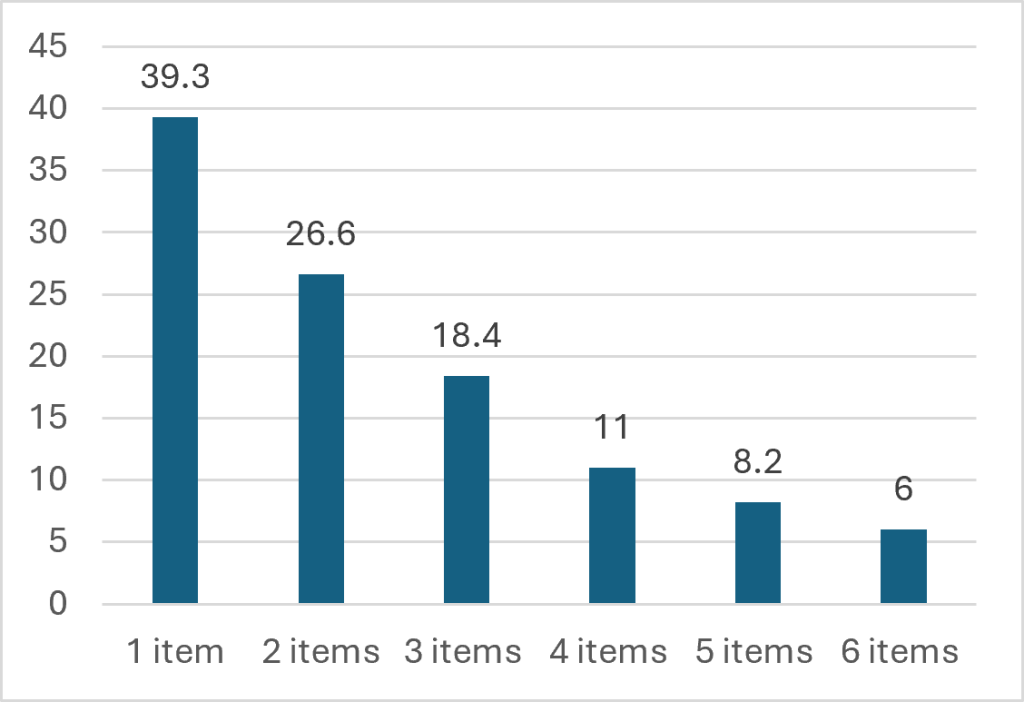
The scale revealed varying levels of deprivation: 11% of kids were deprived of four or more items on it, 18.4% were missing three or more, 26.6% didn’t have two or more, and so on.
Deprivation rate (percent), by deprivation threshold for children
What This Means for Government Policy
Over a fifth of the children in the sample experienced some level of material deprivation while living in a household where the income was above the official poverty line, showing that a tool like the CMD scale would be a useful complement to the Market Basket Measure when it comes to understanding the full extent of childhood poverty in Canada.
It’s also useful for evaluating the success of government actions such as the new Canada Groceries and Essentials Benefit or the ongoing Canada Child Benefit (CCB).
The Canada Child Benefit is based on income, not material deprivation, but the researchers found that it nevertheless tends to reach children who are experiencing material deprivation — albeit while also spending a considerable amount of money on children who are not. That’s because it offers near-universal coverage for families with kids and generous support that only gradually reduces as households move higher up the income ladder.
The CMD scale also sheds light on the concrete material circumstances facing children, who make up around one-third of the clients of food banks across the country. As helpful as the Canada Child Benefit is, there is clearly more we can do as a country to support kids and their families and feed the full potential of the next generation.
Read more: https://foodbankscanada.ca/child-material-deprivation-index/