

On a picturesque rural property north of Hamilton, Ont., Lucas Catalfamo tends to over 10,000 apple and pear trees. During the harvest season, his business, The Apple Orchard, attracts lots of day-trippers and U-pickers from the surrounding area. Last November, with seasonal visits waning and winter closing in, Catalfamo asked his staff to glean as many remaining apples as possible from his trees. He had decided to donate them to food banks rather than letting them go to waste.
Catalfamo is one of many growers across Canada who are happy and willing to direct their surplus produce to people in need. However, it’s often easier said than done. Farms and the nearby food banks often lack the resources they would need to coordinate and act during the short window of time before the food spoils. Plus, the produce is in bulk quantities — more than one food bank could typically give away — and in unpackaged formats that many food banks can’t handle easily, if at all.
In collaboration with Canada’s network of food banks and generous supporters such as RBC, Food Banks Canada is helping to address these challenges. Faced with record-breaking demand, many food banks are at risk of running out of food. To meet their communities’ growing needs, they must tap into all available food sources, including farms like The Apple Orchard.
Food from farms often needs some additional processing. For instance, Catalfamo’s apples often had to be bagged or boxed, because only some food banks are set up to allow clients to pack loose fruit and veggies for themselves. “There’s a lot of complexity involved in going from the field to the table, but with the help of partners and donors, together, we’re making it possible,” says Erin McAllister, Food Banks Canada’s director of national food acquisition.
This past winter at Caledon Community Exchange in Bolton, Ontario, each family receiving food assistance found a bag of potatoes and carrots in their holiday food hampers, thanks to a distribution pilot that came out of this work. “Fresh vegetables are always greatly appreciated!” said food bank manager Kim D’Eri.
Meanwhile, Daily Bread, Toronto’s largest food bank, received 315,000 pounds of potatoes, squash and carrots. “These contributions helped us break a record for produce distributed to our agencies [throughout the GTA],” said Andrew Manson, Daily Bread’s senior manager of corporate partnerships.
Not only is the food itself valuable to food banks, but so is accepting it at their doorsteps in convenient formats. “Having the product delivered alleviated operations burdens,” explained Manson. “And receiving the product in cases rather than bulk allowed us to turn the donations around quickly without putting more pressure on our sort floor.”
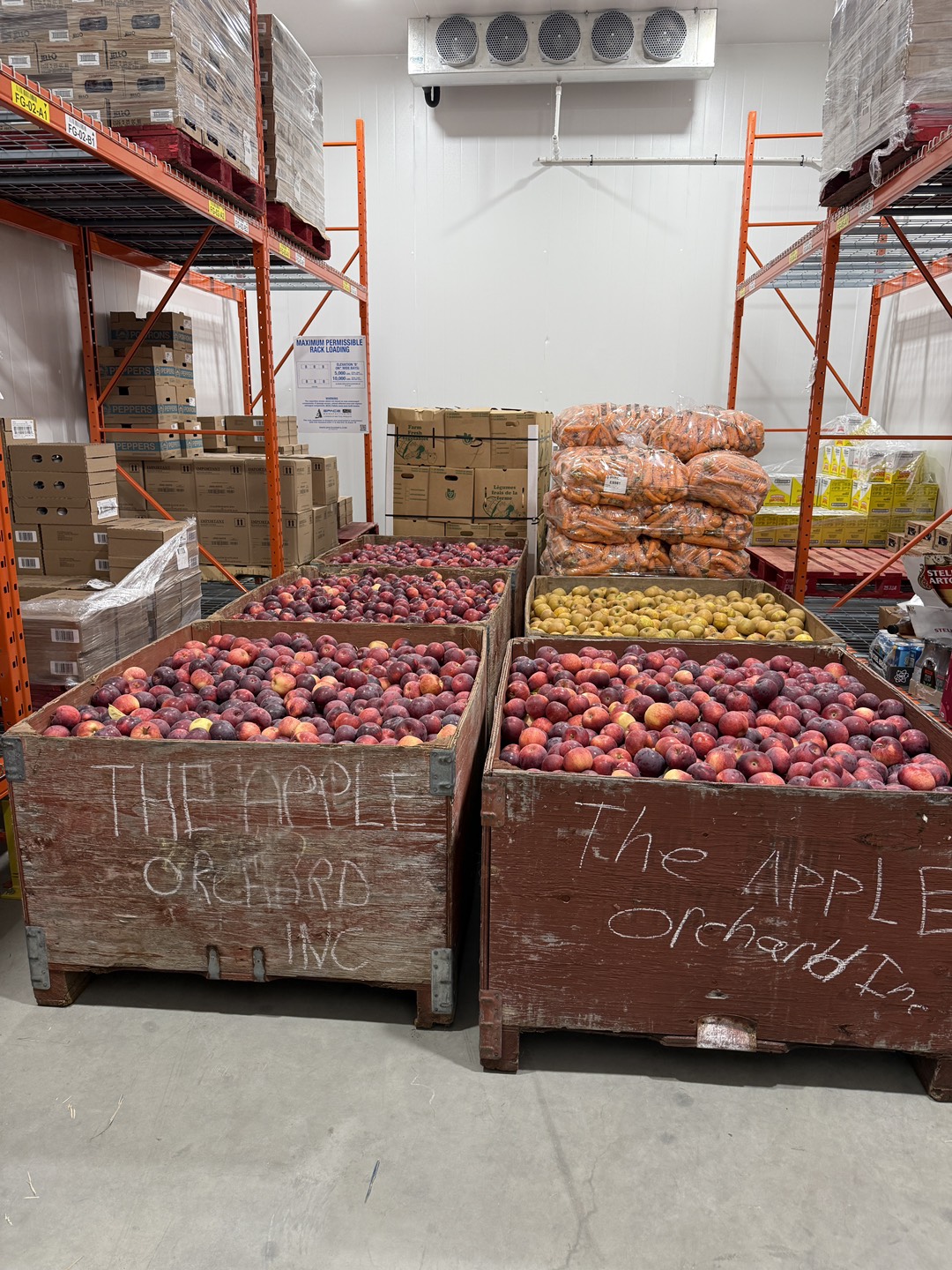
<Photo caption: Apples from The Apple Orchard on the warehouse floor at Feed Halton, a southern Ontario food bank.>
An Innovative Model
Continuing to scale up agricultural food recovery will require investment, especially given the need to convert it into formats that are “food-bank ready.” RBC donated $500,000 to this work this fiscal year, helping the food bank network to forge relationships with growers like Catalfamo and build capacity for processes like washing off excess dirt, packaging bulk food into hamper-sized portions, preserving produce before it spoils, or turning raw ingredients into nutritious and convenient products such as soup.

“Together, we’re improving people’s access to fresh, nutritious food, and reducing food waste,” says Food Banks Canada CEO Kirstin Beardsley. “We’re deeply grateful to RBC for their generous support and shared commitment to helping build a more resilient food system.”
In New Brunswick, a large-scale food-transformation solution is under construction. Greener Village, a Fredericton-based food bank, broke ground on a perishable food rescue centre in September 2025.
Supported in part by Food Banks Canada and its donors, the new 6,500-square-foot facility will be equipped to collect surplus produce from farms and transform it in ways that will extend its shelf life, add value to it, and/or make it more practical to distribute through Greener Village and other food banks in the Atlantic region.
For instance, the centre will allow for peeling, chopping or flash-freezing vegetables. It’s an innovative model that Food Banks Canada hopes to replicate across the country in collaboration with food banks and other partners.
Together for the Common Good
Back at the Apple Orchard last November, Catalfamo hosted a small group of Food Banks Canada staffers, who were interested in learning about his farm, the challenges he faces, and what motivates him to help relieve hunger.
While chatting and gathering information, the visitors helped pick apples for The Apple Orchard’s food-bank donation. Afterwards, they received an email from Catalfamo. “I think it’s so important that we work together for the greater good,” he wrote. “Not only to address challenges in food production, but also to strengthen food security for those who are struggling.”
As far as agricultural businesses go, Catalfamo’s is relatively modest in size. But he reflected upon how everyone has a role to play, big or small, in strengthening their communities. “I think of you and everyone involved [in addressing food insecurity], from staff to volunteers to those receiving food as partners and community members,” he continued. “Every bit we can do brings us closer together.”