

Essex County, in southwest Ontario, is a spread of rich agricultural land that boasts one of the highest densities of vegetable greenhouses in North America. Every summer and fall, the area yields large donations of fresh local produce for the local food bank, the Inn of the Good Shepherd. But just over a decade ago, the Inn’s staff saw snags in this otherwise-welcome influx of tomatoes, cucumbers, potatoes, and more. The large harvest volumes exceeded what the food bankers could distribute, creating spoilage and waste.
“We wanted to get that [produce] into people’s hands,” says Myles Vanni, the Inn’s Executive Director. This food bank serves the wider Sarnia-Lambton area, which includes several “food deserts,” or areas where fresh, nutritious food is difficult, expensive, or downright impossible to access. But how to expand the food bank’s reach? It wasn’t always feasible for residents to travel from some of these locations to the food bank.
In September of 2011, the Inn decided to try out mobile food banking. Each week, Vanni and his colleagues trucked produce and other staples to a low-income neighbourhood and set up a farmer’s market-style table for the day. The pilot was so successful that it caught the attention of surrounding areas. “Other neighbourhoods were saying, ‘Oh, you’re doing it there; what about our neighbourhood?” Vanni recalls.
The following year, the food bank operated mobile markets from July through to the end of October. “It’s just grown from there,” says Vanni.
The Inn is not alone in its efforts. Mobile food banking initiatives have sprung up across Canada as food bankers see how many people in need live far away from a brick-and-mortar location, lack the time or means for transportation, or face mobility challenges.
At a recent Food Banks Canada Learning Lab, mobile food bankers from several locations across the country shared their experiences. The Learning Labs are a quarterly series of topics — delivered via webinars, case studies, and other tools and resources — that enable food bankers to learn about best and promising practices, models, and trends in food banking. Participants gain practical insights, explore new approaches, and get opportunities to collaborate on solutions.
Overcoming Geographical Barriers to Food Access
When it comes to mobile food banks, one major factor affecting both need and feasibility is geography. While the Inn of the Good Shepherd is located in farm country, Loaves and Fishes Food Bank serves as the central food banking hub for Vancouver Island. There are many remote communities on the large and mountainous island whose residents face a drive of up to six hours — often on narrow and winding roads — to Nanaimo for resources.
Alex Counsell, Director of Operations for Loaves and Fishes, says mobile food banking from a central warehouse was part of the answer to this problem. In 2006, his team began operating one satellite location. Now they have more than 30 such locations, 11 of which are in the city of Nanaimo. There’s a market every day of the week at a variety of times, including evenings and weekends for those whose schedules make it hard to come during standard business hours. They partner with churches and work with local volunteers along almost the entire length of the island.
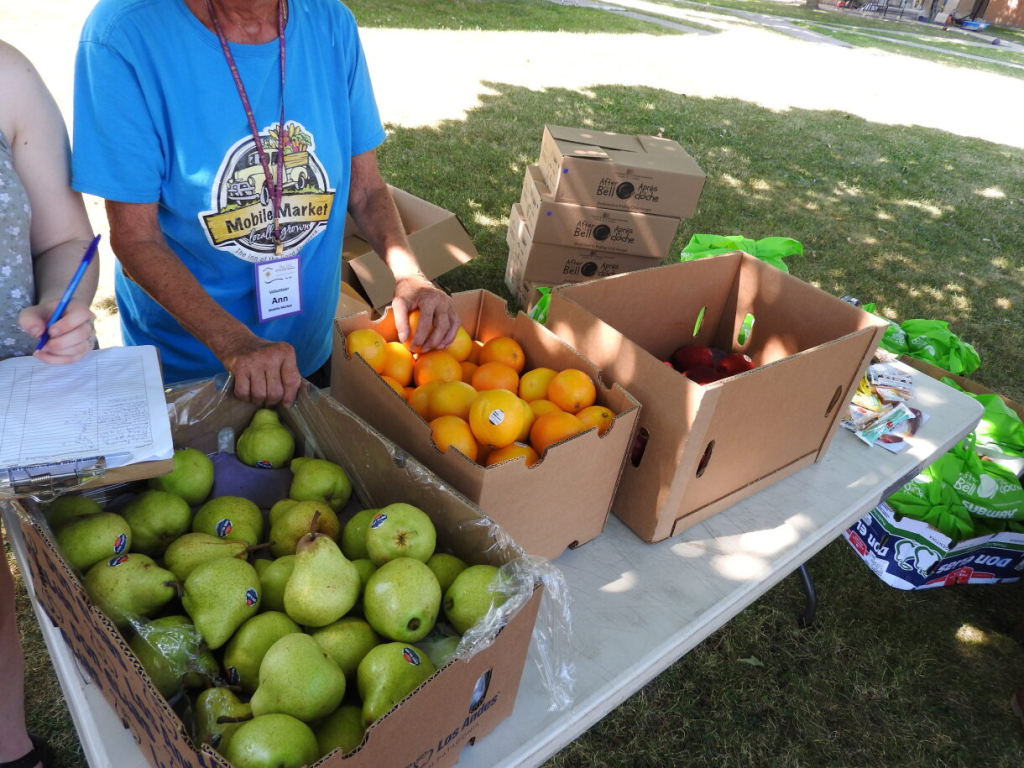
Tables are set up, but hampers are not premade: instead, produce, dairy, deli, and meat are laid out for the day, and clients select items they need and want.
About half of these markets require clients to book timeslots for a visit. Counsell recognizes this approach may not work everywhere but says the system helps the warehouse send the right amount of food to each location so they don’t run out halfway through the day – a valuable consideration when the drive to each location can be arduous.
Cambridge Food Bank in Cambridge, Ontario, also operates a mobile market, and at first glance, it’s a similar model to that of Vanni and his team. Like Sarnia, Cambridge is a southwestern Ontario community with a seasonal pulse of local fresh food, and their mobile market similarly moves produce out to underserved communities. The mobile market here has also nurtured close partnerships with external locations such as community centres, churches, mosques, and seniors’ centres. This helps the market stay predictable, meets people where they are, and so increases uptake. “We are a staple,” says Patrick Doyle, Mobile Food Market Manager at the Cambridge Food Bank. “People could structure their day, their week, around it.”
Key Lessons
Despite some differing strategies, a few common best practices emerge from these examples of mobile food banking. Most important is to engage the community. By working with strategic partners and locations from the start, mobile markets can draw on local volunteers, help get the word out through existing channels, and better reach clients in a new area.
Engaging the community means incorporating additional services, too. In Sarnia, a mobile market may include public health workers, After the Bell snack packs to fill the fresh food gap for kids during summer holidays, or tax experts volunteering for a popular income-tax assistance program. “Often, when we’re working with folks, we find that food security isn’t the only issue,” Vanni says. “Sometimes it’s a symptom of something bigger.” By integrating with local services, mobile markets can become new service hubs where clients can take care of many concerns all in one place.
Another key lesson for mobile food bankers dealing with fresh produce in any significant volumes: invest in refrigeration and minimize handling.
When the Sarnia market began in 2011, produce was stored in an awkward basement walk-in and manually loaded and unloaded each day. This increased bruising and spoilage. The Inn installed a ground-level refrigerated container at its main location a few years in, and three years ago, they added their first reefer (refrigerated truck). This system lets them move far more produce with minimal handling and keeps it viable longer. Loaves and Fishes and Cambridge have also invested in refrigeration infrastructure.
Food banks that wish to do likewise but lack the means are encouraged to apply for one of Food Banks Canada’s Capacity Boost Grants, which are designed to enable food banks to safely handle more food — and fresh food in particular.
Whatever the mobile market looks like, everyone seems to agree on starting small and building slowly. “Don’t expand too quickly,” Doyle says. “Expand organically.”
For Vanni, this approach has paid off. In 2025, the Inn operated 18 mobile markets around the Sarnia–Lambton area in low-income, rural, and First Nations communities. From July through October of this past year, refrigerated trucks headed out to a rotation of locations depending on the day, seeing eight or nine thousand pounds of crisp, fresh food delivered each week.
Vanni sees clients delighted with their options at the mobile markets. “Kids would run up and grab a pepper off the table and eat it like an apple,” he says.
Even as need grows in Canadian communities, food bankers are rising to the challenge, and mobile food markets show these efforts at their most innovative and impactful.