
York Landing, Manitoba, home to approximately 480 members of York Factory First Nation, is rooted in Ininewak values, where ensuring everyone is fed resides at the centre of the community’s culture. Yet, like many Northern communities, it is dealing with increased levels of food insecurity because of factors that include historical injustices, limited employment opportunities and high transportation costs.
During the summer of 2025, a confluence of weather events and conditions made the situation even tougher. First, York Landing’s ice road had opened for only around a month the previous winter, whereas it used to enable wintertime shipments for closer to three months. Then, extremely low water levels on the Nelson River prevented the summertime ferry boat from operating reliably, leaving the community isolated during a time of year when it was used to a relatively steady supply of goods, including market (commercial) food.
Making matters worse, wildfires raged in the region from late May onwards, filling the air with unhealthy smoke and preventing people from going out to harvest country food (food sourced from hunting, fishing, gathering, etc.) “We also had to be ready to evacuate at any moment,” recalls Danielle Sinclair, the Harvest Program Coordinator for York Factory First Nation. “People had their bags packed, ready to go.”
“Flights were getting cancelled,” she continues. “There was no more road access going down to [the nearest city of] Thompson to shop. The Northern store here lost power for over a week. There were no eggs, no milk. As you can imagine, we were on edge.”
Climate change doesn’t touch every region in the same ways, and so far, the Arctic and sub-Arctic have experienced some of the most dramatic effects. Severe and irreversible changes to landscapes and ecosystems are “negatively impacting the health of Northerners, amplifying existing inequities,” states Canada in a Changing Climate: Regional Perspectives Report, part of an ongoing federal assessment.
Sinclair knows this firsthand. “And who’s in the North? Indigenous people,” she adds. “We’re among those who are most impacted.”
“Food Sovereignty Comes First”
Danielle Sinclair recently returned home to York Landing from Vancouver where she studied conservation. She took on a role in the community’s on-the-land hunting and harvesting programming, and that soon put her in touch with Food Banks Canada, which had awarded a 2025 Emergency Food Access Grant to York Factory First Nation. The funds were earmarked for gift cards and vouchers for market food, as well as snowmobile fuel for a moose-hunting trip that was expected to bring plenty of nutritious and culturally significant meat into the community.
But in July, with families struggling and snowmobile season still a way off, Sinclair got in touch with Food Banks Canada with a request to spend York Factory First Nation’s Emergency Food Access Grant as soon as possible.
“It must be stressful in the community right now,” answered Nolan Wadsworth-Polkinghorne, a Northern Program officer at Food Banks Canada, in an email. “I’m glad folks have you thinking ahead, trying to manage things before it turns into crisis.”
After swiftly helping Sinclair to secure approval for the change of plans for the grant money, Polkinghorne and his Northern Program colleague Jay Stevens put her in touch with organizations that could help stretch the funds as far as they could go. The Wiiche’iwaymagon Food Buying Alliance, Harvest Manitoba, Second Harvest and Manitoba Keewatinowi Okimakanak all joined York Factory First Nation and Food Banks Canada in sourcing food and transportation.
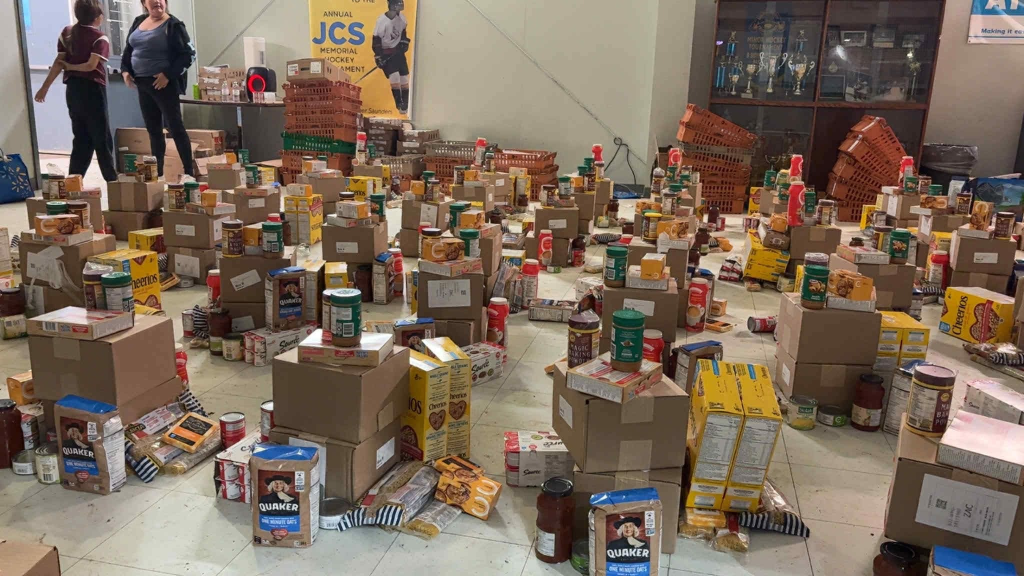
“It took about three weeks of planning and coordination, but then the food shipped,” says Sinclair, who sent a ground crew to the local airstrip each day to pick up new deliveries. “Over 20 pallets came in total. There was tuna, beans, soup, pasta, rice, corn, chicken: all kinds of stuff. And it was awesome to see local women working on the ground crew and realizing their potential to contribute to the community in that way.”
According to custom, elders were served first, but there was enough to share with everyone. “We have a community Facebook group, and people were cracking jokes there like, ‘Who keeps bringing us all this good food? We’re running out of things to complain about!’” laughs Sinclair.
In reality, she adds in a more serious tone, many people in York Landing continue to face food insecurity. “We need immediate relief but also long-term solutions.”
Through its Northern Program and Northern Capacity Fund, Food Banks Canada aims to equip and expand locally led food-security initiatives such as the Harvest Program that Sinclair coordinates. We also advocate for systemic policy changes to make food — and the rest of life’s essentials — more accessible in the region.
Sinclair envisions a future where Northerners get all the training, tools and infrastructure they need to foster food sovereignty. “When you’re worried about food, all you can think about is food and feeding your family,” she says. “For First Nations people interested in revitalizing our sovereignty, food sovereignty comes first.”